Mabh Savage, When the Wind Stole my Homework -poetry

I’m sure it was ecology
Something alive and organic
That led me to be out in the trees
And laughing madly
Into the wind.
Books forgotten; no, a lie.
Books are the seeds in the core of this fruit
Books written just around the corner
By women as curious as I
Less fortunate though

Cursed to live in disease and sexism.
Both killers of body and spirit;
How lucky am I.
But the books I scrawl my facts
And figures
And answers
And notes
Are forgotten scraps of yesterday:
He asked (my angel)
‘What do you like best and why?’
I sat on the edge of the desk,
Eyes shining and soul
On my shirt sleeve
And said one thing, then another
Mind skipping like stones
Across a lake.
Worried at first that he will read
Far too much into my final answer
Then (crazy hormonal child)
Eventually not caring if he does.
Because the answer is true.
And it’s not conventional.
It’s not everyone else’s favourite.
It’s mine because it speaks
To something within
Bypassing ears and mind and launching
Arrow like at the heart of the matter.
He is pleased, so I am;
The measure of a great mentor.
And as I leave,
I think of all the things ‘I like best’
And realise none of them
Are for anyone
But me.
So here I am, running deer like
Through woods and over stones
Praising those words that found
The key to introverted me
And turned, and listen;
The grinding of gears
As the lock opened,
And me me me poured out through
That portal like sunshine.
Throw those papers to the wind;
Let devils grasp and play
What do I like best?
I’ve only just begun to say.

© Mabh Savage 
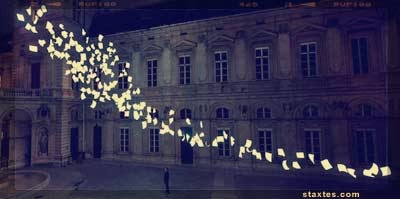
Photo©By designer Paul Cocksedge “Bourrasque” -collection of papers blowing away in the wind. Made for France’s City of Lyon’s annual Festival of Lights 2011

*

Mabh Savage’s book “A Modern Celt» is available to order at Amazon 

Daniel de Cullá, Haikus

HAIKUS BY THE SEA

In the dry on sea
A new wave for lifelong
The great white shark.

Te sum of laughter:
Kids splashing in the pool
On the lounge chair.

To salvage Life:
A visible catheter
On the Earth’s bend.

Taking you food
With you saves quite a lot:
Money for one.

When fear, terror
When pain, loss and worst, love.
You can’t feel alone.

Up the spirit of
A worthwhile wo/man being:
The girl’s white dog.

AFTER SAILOR’S FUNERAL

Small leaves
Like the palm of a hand
Tremble on its own.

Pollen-yellow horns
Examine swallows
At our touches.

Early May not long
Garden littered with shells
Thinnest tissue.

After funeral
Families retract at touch
It hugs the steam.

It’s easy to say
“The word love fucks in yr bed”
Always your own¡

HAIKUS OF THE GREEN OLIVE

Subverted Life:
Religions have perverted
The Free Spirit.

The Sacred Chao
Is for these screwed-up times.
Speak for Yourself¡

Deities change.
Gospel according to Freud
From de Dog Star¡

Erotic Poetry
Is a telegram for us?
Book of Uterus¡

Face to face with You¡
The Epistle to Paranoids
Is for Polites.

Each of these yarns
And my past to spread them:
Whole thing myself.

I got the Record
About you will learn more
And understand less.

Everything knowing
With Principia Discordia
About Nothing.

Knowledge of a sage
Put twinkles in Your Eyes.
Wisdom of a Child¡

EVIL’S HAIKUS

How I found a God
A few moments of a Shit
And what I did It.

I feel that the Book
Is a classic for a Dog
Hah¡ Delusions.

Clasic Discordia
Of guerrilla ontology
Deadpan put on¡

A Love Story
I don’t know You Wo/Man
Five tons of Winds¡

A Discordian Chao
There’s no God but Goddess
And my prettiest One¡

HAIKUS ANDALUS

The bud uncurls like
ruber tube protruding
Viatical settles.

Curtains open
You can’t live on love
gardenias on deck

Granada on the paint
behind the blond armoire.
You, Don the Garden

Big wave averted
as Sea walks away sea falls
waves behind Me.

An opening hand
on the Andalus patio
geranium to bloom.

*

©Daniel de Cullá
photo©Stratos Fountoulis «Paros 2008»

bio
Daniel de Cullá *1955, Poet & Writer. Painter & Photographer. Member of the Spanish Writers Association. Founder and Editor of the reviews of BodyArt, Art Culture, GALLO TRICOLOR, and ROBESPIERRE. He participates in Cultural Acts of Theatre and Performance. He’s living between Burgos, Madrid and North Hollywood.

Pauline Rowe, whispering like a wound -poetry


Story of a Rented House

It was made of ice-cream, at a glance.
No house should be yellow. We knew it
and said nothing.

We were foolish to lie there,
to make love and think the walls
would keep our secrets.

The place made notes and sent
regular reports to his mother
who placed a curse on my foolish head.

The telephone wires took messages
from the snow queen, played the words
back in his dreams so he thought me a traitor.

He sat in the dark as I worked in the evenings
as the windows closed like the eyes of the dead.

I left early one night as
I heard him call my name. I swear.
But he was not there,

he was not outside,
he was not in any room,
he was not making music,

he was not waiting
for me

he was not waiting
he was not ever waiting
ever waiting
ever again.

*
Shirt

She can’t renounce the colour of his shirt,
its warp, its weft, the slightest scent of it
how, like a ghost, the movement in his hands
roots out, haunts her history in the dark.

His lips, the gentlest breath now finds her skin
draws a careful map; how transparent loss
can only be observed when certain light
catches it, the ink of night in traces

embroidered by creatures with slow purpose
as though the tiny light of centuries
were threaded microscopically in stone.

Norman tapestries offer up their hands
yet of this holy shirt that held his back
just shade remains, remembrance of pale green.

 
*
Demeter’s Dedication

I go out to shoot everything
ahead of the hunt; foxes, rabbits, otters,
peacocks, doves, parakeets, macaws.

Red’s in everything, the ecstasy of summer gone:
my breasts ache with the memory of milk.
My daughter, blind to winter, turns her back

I smell the anxious dead gathering
to witness her return, hear cold sunshine
whispering like a wound, singing songs, telling tales.

I can, at least, describe this waiting,
testify against the lowest of the low –
that rancid, hollow, stinking thing
who stole her from the day
and calls himself a god.

I will make the mountains cringe,
the rivers boil with human dead,
colour them full of poisons, break out
from their boundaries, invite the busy harbours
to collapse, call the seas into cities,
command volcano dust to choke
the Western hemisphere,
invite ice to claim dominion
where it can.

I walk always, I have no choice
while she’s imprisoned in her crimson bed,
her dungeon in the underworld.

I liquefy the silver of the moon with mercury,
pour it like a jug of cream over the ocean.

I heard you crying in the dark
my beloved child, my girl.
He took away the lanterns,
snuffed out all the stars.

Across the continent, my grief of grief
becomes a dance of death.

*
©Pauline Rowe
photo©Stratos Fountoulis, «Shopping Centre 2013»

*

Pauline Rowe lives in Liverpool and works as Poet-in-Residence at Liverpool Mental Heath Services (Mersey Care NHS Trust). She also works on writing and well-being projects for the charity North End Writers. Her collection Waiting for the Brown Trout God (2009) was published by Headland Publications.
She has an MA in Writing and Reading Poetry and is in the first year studying (part-time) for a PhD at Liverpool University from Oct 2013, researching the uses of poetry in mental health services.
She has worked with a range of organisations including FACT, Liverpool Poetry Cafe, Shrewsbury House, Liverpool Library services, the Greenbank project, Tenantspin, BBC Radio Merseyside and Project 51. Contact: northendwriters@gmail

Sotirios Pastakas, “a tongue-tied apology” -poetry


XANTHE*

to Daphne Georgiadou

A cockroach resting
between the washbowl 
and the mirror, motionless,
there, half-way up
the grey wall.
In the cobbled streets
the same old footsteps,
the feet going pit-a-pat
along the alleyways,
the trot

of a woman passing and gathering
pitter-patter men’s
glances, she gathers them 
pitter-patter and tucks them
into her midi skirt.
They climb up
her thighs,
they turn into a cockroach,
they halt on her hips.
Glances-cum-insects
glances slithering up
to her pliant waist,
her lush bust,
her protruding tits
that break first 
men’s hinting 
tape. Men
beckoning 
everywhere, 
tipping the wink 
men devising 
the same old 
tricks, ploys,
fallacies,
compliments.
The cafés
are full of men
sitting on chairs
in fours.
Men erect
standing 
on the pavement 
in a state of expectation,
leaning over to stamp out
their fag-end.
One is bending down
to do up his shoelaces,
another comes to a sudden stop
and bids you a simple “good morning”,
another turns round as you are passing
and whistles at you,
yet another is standing stunned
at the butcher’s entrance
and is slow getting out of the way
allowing you to pass, mumbling 
a tongue-tied apology.
The baker smiles at you.
The haberdasher tells you:
“You look lovely today,
Madam!”
The greengrocer offers you
a split pomegranate.
Someone else greets you
by ringing 
his bicycle bell,
rhythmic and melodious.
Same streets,
same men,
same distance
for twenty-seven long years,
the glances mercury
on you, and some others
red beads
round your neck.
The trip on your back
in a low-necked blouse 
since October’s 
voluptuous sunny days 
allow it.
The birds are singing,
the cars are speeding by,
the men pause and look around,
your buttocks are swaying
on high-heel boots,
the days are shortening.
In the streets and squares
your yesterday’s admirers
are aging adolescent
in the same cafés.
The province is an inexhaustible
supply of enthusiasm.
Transplanted vision
always leads us 
to the same streets,
and when we lose our way,
a couple of steps further on 
there’s a half-open 
window, jasmine 
in bloom, you arrange
your hair,
a slim-waisted, stylish 
figure
ducking 
at the War Memorial
to avoid the machine gun’s
barrel.
She dabs her lips with lipstick 
on the sly, on the quiet
she sends an SMS
on her mobile phone
under the table.
She ignores a call,
she is either not connected to this line
or has her phone deactivated
for one-third of the time.
She receives flowers from strangers,
red roses,
mouths half-open for a kiss,
red lips, 
greedy lips that know 
how to bite an apple,
to cut a thread
with their teeth, to sew up
silence and smile,
dyed conversations,
kisses on a bench,
a butterfly at rest
on the tip of a leaf,
your face once again
an outlet for pedlars
and beggars in the hum
of the streets.
Your face, 
an embroidery 
on a shop window,
in a shop window.
Behind a café’s 
glass windows dozens
of man’s faces.
Your face on
a glass window, you pause,
you straighten your eyelashes somewhat,
you try a smile,
you start walking again,
you rise, travel,
get lost, arrive,
your face deforms,
your figure is nondescript,
only your eyebrows 
and your eyes will be ours.
Your father’s nose is
that of our fellow-citizens,
the mass of hands
that have yet to touch you,
words have not wounded you,
hugs have not made you dizzy,
lovers’ shapeless profiles,
flat excitements,
inexplicable passions, stickabilities ,
unforeseen love affairs,
offhand flirting, 
rough and ready sex as usual,
unexpected love.
Start walking,
share out your body,
stop and listen
to the country’s music,
sense a musical phrase,
a note announcing
a Hadjidakis** instrumental piece.
Admire your lissome shadow
in men’s looks.
Hear the masculine confessions
from one who weans away
from the crowd and follows you
step by step, keeping a lover’s distance
as far as your house, 
because your house is built
of stone, lips and arms,
an untidy girlish 
bedroom, sheets in a mess.
She undresses 
in the steamy bathroom,
the cockroach having 
traced out its route,
the mirror naked,
my daughter bathes 
after her stroll
to the Xanthe 
Progressive Union. 

©Sotirios Pastakas
The town of Xanthe, vintage photo 1930 


*

*Xanthe: The capital of the province of Thrace.
**Manos Hadjidakis (1925-1994): Internationally famous Greek composer.

Translated from the Greek by Yannis Goumas

Ali Znaidi, “the cinders of an ongoing memory” -poetry

 
A Dejected Morceau

in this abattoir

of

symbolic

disintegration

the loud

clashing tone

of

dream fragments

started echoing,

& the tinkling

cymbals

began to clash

for a slaughtered bird

w/ its retinues

of gloom

Memory’s Cinders

all sprang from those endless
nights—

endless wild parties of the
bats playing havoc
w/ the frosty spiders’
cobwebs,

endless flashing lights of the
fireflies

& most and foremost from
the cinders of
an ongoing memory—

headaches, blazing

Self-explosive Sleaze

Sleaze is weaving sonnets
around its halo:

embellished sounds &
con[fluent] words,

& above all, a fascination w/
syntax—

an insatiable balloon feasting on
more air adorned w/
flowery language—
a basic sustenance
for self-
——–destruction.

*
©Ali Znaidi
photo©Stratos Fountoulis «Flamengo night in Barcelona, 2008»

bio
Ali Znaidi lives in Redeyef, Tunisia where he teaches English. His work has appeared in The Rusty Nail, The Tower Journal, Mad Swirl, Red Fez, Unlikely Stories: Episode IV, BlazeVOX, Word Riot, & other ezines. His debut poetry chapbook Experimental Ruminations was published in September 2012 by Fowlpox Press (Canada). From time to time he blogs at – aliznaidi.blogspot.com

Panayotis Pakos, Les Innumerables (A Binary Tale)

In front of its old, grand round mirror, 2 wriggles its long, slim neck, preens the plumes at the end of its tail and gloats. You are 2, it smiles at its reflection; no other can be you.
A few blocks away, 8, also in front of its round mirror, loosens the belt around its waist, and indulges itself in the sight of its perfect, even curves.
Whoever set their eyes on you and think that you are 4+4 or 3+5, are talking nonsense. They have no eyes to see you as an individual, independent, complete being.
At the other end of the City, 1283 contemplates the consequences of being 1283. I am not an ordinary number. I am integer and prime. There is no other number that represents the concept of 1283; I alone express this singular and solitary concept – one that blesses an equally singular and solitary being.
Every night, countless numbers leave such thoughts and words at the feet of their mirrors – offerings to the round god who bears their figures. Then they go to bed, cross their pillows and brood their sphereal dreams: each of them unique, as is their dreamer.
Every night, when all the numbers fall asleep in the Eternal City, One visits each house and gently wipes the round mirrors clean; and they, wrapped in the thick shroud of darkness, lay off the burden of their reflections – for a few hours they become, once again, small, plain noughts…
©Panayotis Pakos
Unnknown photographer, Colorado lisence plate, 1922 
 

Sean Brijbasi, koto

 
To travel far as a child is fraught. Boats capsize. Airplanes crash. Bicycles fragment into unusable pieces of metal onto the ground.
   The ocean is not an ocean. It is a body of water that meets the land. But it is an ocean. The horses and dogs that run wild on the thin strip of sand before the rocks have permission from the earth. But we too have permission. We too have muscle. Not as strong or as sinewy as the nobler animals but with the same kinetic desires. And so we run, my sister and I, from the gate of our house to the beach while the youngest in our family sleeps within the mosquito net, beneath the fan, the hum of which synthesizes the sounds of chickens and goats coming from the yard outside our house so that this family’s youngest, this young boy we call brother, may sleep in good time.
   My sister and I run with new muscle that expand and stretch and push our bodies forward. We run in the air that comes from the ocean—that flows over the animals and bids us to carry on. We are as fast as they and soon move among them until I fall and hear the wind and the hammering of hooves against the earth. My uncle runs out and pulls my sister away as the horses run by. He covers her face and looks down the thin strip of sand to see a small explosion of dust where I have fallen. Inside this nebula I am mutilated and bleeding. This was my first death.

*

© Sean Brijbasi, excerpt from his latest book «the Dictionary of coincidences, Volume I (Hi)«
photo© Stratos Fountoulis, “Olive oil variety” Brussels, 2012 -p/o the original photo used for the cover

*
Sean Brijbasi
the dictionary of coincidences, Volume I (Hi)

You can buy the book 
– at Pretendgenius Book Store
– at Amazon
– at Barnes and Noble

Uche Ogbuji, “Sunlight stealing over the ragged edges of scar” -poetry


Lashed

Your insouciant lashes of black spiral,
Wound-up, cheeky veiling invades our opened lips,
Bluffed off high-brow, sweeps in to garnish tongue-tie-up.
Laughing, you marshal

Your insurgent springing of wild-grained impulse,
Breaching lives of / mouths of the poets, whispering salt,
Brushed off, rebuffed, bitten, yet still stuffing goosed
Klatsch with the carnal,

Ginseng-spiked polite-coiffed head-cock («upstairs»),
Gimlet-stirred blend of your hips with mine, as I
Pattern breaths to sip this deluge of embrace,
Pacing that last gasp.

Your wild coils grow themselves into my weirding
Voice, betraying all suaviter in modo,
Plucking out a fortiori claims to cool,
Fringe-framing the ruined mask.

Shyness ever follicle-foiled, recedes, what’s
Left’s the gag, insisting on grit, no grinned jest.

Swept along in white water I’m bent, buried,
Bound up in silk sedge.

***

Fire Next Time

It’s as if that vengeful god has called;
He’s up the sky soon to be burst with terrors
That serve us right for existential crime;
Not satisfied with nasty, brutish, short,
He’s fashioned out a fathomless device
And rigged it to the doomsday clock’s last chime.
They sing: ‘God gave Noah the rainbow sign,
Warning: No more water, but fire next time!’

What was our error? Skulls have sealed it out!
The cosmic imperfection marked by matter?
Revenge for particles that botched their rhyme?
Did that blemish in the firmament
Mean God spent six days cleaning up the mess?
Were snakes and apples wrath from lost sublime?
They sing: ‘God gave Noah the rainbow sign,
Warning: No more water, but fire next time!’

The tracts claim proof from a Russian borehole:
Shrieks of the dead awaiting late invention
To remind us hell prefers us in our prime;
And yet they talk of purifying fire—
Though Heracles was superman it took
The burning shirt to stage his gospel mime.
They sing: ‘God gave Noah the rainbow sign,
Warning: No more water, but fire next time!’

***

Zounds

Accumulation of stuffing,
Peep of royal blue background,
Opacity fifty per cent,
Diaphanous shift of Cybele,
Red for sacrifice, blue for nobility,
Tight knot of clinging zero,
And a fairy foreground of sandy flat;
Lumpy grid of leathered farm plots,
Fleshly insistence of cloud,
Numinous nubile in coy caress, withdrawal,
And endless depth once broken,
Sunlight stealing over the ragged edges of scar,
A pooling of blood into the crease,
A blinding upturn in the sea-surface cipher,
Inversion of the firmament,
Immediate the Aphrodite foam
Like forelocks on a young victim,
Immediate the fruit pulp
Like blanch of votive dress,
And even more immediate, the breach,
The cirrus to stratus to cumulus drop,
The telescoping to bone-hard ground,
Air drawn from the gut like a summoned salve,
The cloud-bound burn-curled
Like edge of injured flesh,
Abrupt tent of scabbed defense from sunbeam,
White blood cell pallor and serum yellow of storm top,
Stalactite chill of inexorable vector,
Raindrop of milky chalk descent.
Safeguard from indistinction below
Is the burst of your memory;
The splash of shrinking warmth in expectation,
intercession of your clay-grace divine,
God body indistinct in its aerie height,
From which eye ichor, blue sea of light,
From which duct salve of slate-shade rain
Low pressure dressing of gods’ own pain.
Ilu Igwe is my vehicle
Anyanwu my regard for you
And all fresh wholeness of my love—
Ala, approaching, overdue.

——————–Notes: Ilu Igwe, Anyanwu and AlaIgbo gods & goddesses of, respectively, heavens, sun and earth.

*
Brandy Lève Tôt

Crack of dawn by thunderous signal: Train comes
Soon and she unzips the burden of night time
Baggage, Spills herself into day, the first class
Carriage of moment.

***

Twit Jug

Twit twit twit, so rude the force,
Looted lineaments of torse:
That old tale of Philomel
Who from her cell, snared and hoarse,

Wove Tereus’ outrageous course,
Hark his hoop-cry of remorse,
Moan over the eaten child,
The line defiled, royal divorce.

Jug, jug, the sound sometime coarse,
In mythic context even worse,
From Thracian Greek to Cockney,
Songs for Procne haunt the gorse.

*
©Uche Ogbuji
photo©Stratos Fountoulis, Summer 2008

bio
Uche Ogbuji (@uogbuji) was born in Calabar, Nigeria. He lived, among other places, in Egypt and England before settling near Boulder, Colorado. A computer engineer and entrepreneur by trade, his collection of poetry, Ndewo, Colorado is forthcoming in 2014 from Kelsay Books. His poems, fusing Igbo culture, European Classicism, U.S. Mountain West setting, and Hip-Hop influences, have appeared widely, most recently in IthacaLit, String Poet, The Raintown Review, Featherlit, Outside In Journal, Don’t Just Sit There, Qarrtsiluni, and Leveler. He is editor at Kin Poetry Journal and The Nervous breakdown, founder and curator at the @ColoradoPoetry Twitter project.

Learn more about Uche’s forthcoming book!

Visit All «English Wednesdays»