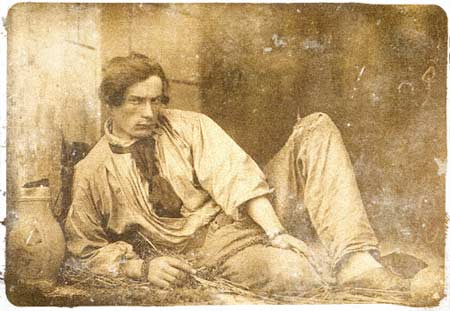
Brenda Wilson Wooley, Pencil Fingers

He sashayed into my life without warning and ran away with my heart. “Konstantas Dimitri Papadopoulos,” he laughed, “But you can call me ‘Costa.’”

We met at my best friend’s wedding. I was maid of honor; he, best man. Slim and graceful, with startling black hair, his high cheekbones and arched Roman nose put me in mind of a tall, slim Al Pacino. Although his true love was art, he made his living as a chef at an upscale Manhattan eatery. He had recently moved back home to the Detroit suburb of Bloomfield Hills to pursue his dream.
“It’s now or never; I’m giving myself one more chance to make it with my art,” he said, “If not, I guess I’ll be forced to give it up.”
Costa was electrifying, impulsive, and dangerous; a free spirit, one of a kind. The most exciting man I had ever met. It was only after we married that I realized there were two sides to him. Many sides, really. But the good times were so enchanting that I anxiously awaited them. He encouraged things I would never have done before he came along, singing our favorite Air Supply song, “All Out of Love” in a packed Karaoke bar, running naked in the rain, smoking pot, flipping the bird to drivers who cut me off on Telegraph Road. And trading obscenities with him during our screaming fights.
He painted my portrait as I lay naked on our bed, his worn bomber jacket draped across my thighs. He taught me Greek dances as the musicians strummed their mandolins in the dark, cozy bars down in Greek Town. He took me to Reggie’s, where we danced the night away to the old Motown sound, and to Flood’s Bar & Grill, where we dined on soul food and listened to smooth jazz.
But the best times were our nights at home. And the best of them all was the rainy night of our last wedding anniversary. He zipped around the kitchen, preparing Spanakopita, Dolmathakia; Moussaka and Baklava, yelling “Opa!” as he lit the flame, squeezed lemon juice and a smattering of Cognac over the sizzling Kefalotere cheese, serving it all with the pizzazz of the superb chef that he was.
Costa dined like he made love, slowly, savoring each course, a look of pure joy on his face. “What a delight,” he said, taking sensuous bites of the filo-layered spinach pie, tangy stuffed grape leaves, creamy Moussaka. Washing it down with cheap red wine.
“More Dom Perignon, madam?” he said, bowing gracefully.
Everything about him was graceful: his long, slim legs whirling me around the dance floor; his flowing arms, pretending to direct an orchestra when he was tipsy from too many Rusty Nails; his artistic fingers, so long that friends called him “pencil fingers.”
We planned our future as we smoked a joint, legs entwined on our old tattered sofa. “You’re the next Eudora Welty,” he said, tracing my eyebrow with one long, tapered finger. “You’re the next Jackson Pollock,” I said, running my fingers through his black, silky hair.
Later, his gold-brown eyes held mine as we made love to the sound of the rain falling softly on the eaves.
But, like flipping a switch, things always changed.
“Why are you ruining it all?” I cried.
We had just arrived home from visiting an Air Force buddy who had served with him in Vietnam. We had enjoyed a lovely evening with Mark and his wife Cindy. Until Costa and Mark closeted themselves in the den with a bottle of Ouzo. Cindy and I sat in the living room, trying to ignore their talk about “Nam,” the Viet Cong, “jarheads,” babies with bombs strapped to their diapers and whores with razor blades in their vaginas. Subjects which had become all too familiar to me.
“You don’t understand, Sarah, you can’t possibly understand,” he said, “I’ve fucking murdered men, women and children. Babies, god damn it, tiny, innocent babies!”
I held him in my arms until he fell asleep. And I lay awake the rest of the night.
“I promise that will never happen again, sweetheart,” he said the next morning, taking a sip of tomato juice mixed with hot sauce, his cure for a hangover.
“You need help.”
“How many times have I told you, I’m not going to a god damned shrink? They don’t understand. Nobody understands!”
The nightmares began coming more often, the night sweats and flailing, scrambling for cover. “Gooks!” he screamed, “Look! They’re right there in the bushes! Fuck! Watch out! No, no, no!”
He clung to me when I awakened him, thin body slick with perspiration, hands shaking as he lit one Marlboro after another. He never slept after the nightmares. Not that he slept much anyway.
He began spending more time away from home, obsessing about Vietnam, painting less and less, fits of anger, fists through doors. And his infidelities.
“Give me another chance, my love,” he said, gathering me in his arms the mornings after, “Please.”
And I did. Time after time. But I felt I was hanging by a thread at the peak of a cliff, slipping toward the swirling abyss below.
And, as it turned out, I was.
It was around three o’clock on a freezing February morning when I received the call. I don’t remember getting dressed or even leaving the house; I suddenly found myself speeding down 13 Mile Road, sleet spitting at the windshield. And when I arrived at Beaumont Hospital, all I could see was a clutch of people in white, all staring at me.
As the doctor moved toward me, a thin veil descended over my vision, dim and moving, shifting and blending, mind numb, body frozen, thoughts fading in, fading out. He spoke the words in a soft, gentle voice, the sounds around me receding; muffled, like underwater. But they struck with the force of a sledgehammer.
“No!” I heard myself cry out through the haze, “No!”
I waited two long weeks before I let them take him off life support. Thick, heavy snowflakes drifted past the window that cold, gray morning as I kissed his parched lips, touched his smooth, familiar face, caressing his hands and committing to memory his long, pencil fingers.
I am no longer the woman Costa knew, nor am I the woman my family and friends know. She is boxed up; put away, along with his cards and gifts, pictures, the painting of me with his bomber jacket draped across my thighs, and the tiny gold locket in which I placed a lock of his black, silky hair.
There are times, though, when the faint strings of a mandolin drift through a soft summer night, or I hear Air Supply’s “All Out of Love,” or a Greek waiter yells “Opa!” and I am cuddling with Costa on our tattered sofa, his gold-brown eyes holding mine as we make love to the sound of the rain falling softly on the eaves.
©Brenda Wilson Wooley
photo © Stratos Fountoulis, «Hoeilaart», 2011
bio
Brenda Wilson Wooley’s work has appeared in more than forty-five publications in the United States and around the world, including The Birmingham Arts Journal, Kentucky Monthly Magazine, Barely South Review and Looking Back Magazine. She lives in Paducah, Kentucky, where she is working on a novel.

Stephen Regan, Behind the cheesy show title, a profound truth

Sometimes it is clichés such as ‘Stop the World – I Want to Get Off’ that best capture the zeitgeist.

 In the turmoil of the 1960s, even as a small child, I realised there was something profound in that phrase, oft-uttered back then. It’s retained popular currency through the decades, though not because of any great fondness for the eponymous stage musical, which is a piece of cheesy sentimental claptrap.
   The show is about a man dissatisfied with his life, seeking solace in the arms of various women. He’s searching for something better than he has, only to realise, eventually, that it’s the love of his wife that matters. Talk about conceptual mediocrity …
   But, now, when I’m in my mid-50s, and the world rushes by in a blizzard of trashy images and infotainment crap, I realise that ‘Stop the World – I Want to Get Off’ is an accurate way of summarising how so many humans feel about living today. We are fatigued by the relentlessness and increasing infantilism and narcissism of digital communications.
   I remember the moment, a couple of years ago, when the phrase re-injected itself into my consciousness with renewed vigour for the modern age.
   ‘Stop the World – I Want to Get Off’, I thought as I handled newswire copy about Lady Gaga dressing up in strips of meat to make a point about human rights, apparently.
    She was parading around draped in offal at the MTV awards in LA.
   “If we don’t stand up for what we believe in and fight for our rights pretty soon, we are going to have as much rights as the meat on our bones,” she cooed. “And I am not a piece of meat.”
   Er, yes sweetheart, all right, you’ve made your point, now move along, you’re beginning to stink the place out.
   As a craft-trained British newspaper journalist, I feel the news has gone weird, with showbiz dross everywhere, thick tarts (men and women) on and off football fields, and telly programmes designed for morons.
We’re heading to Hades in a Ferrari.
   When I first started in newspapers, there was a typewriter and an ashtray on every desk, a bollocking editor in every newsroom, union posters on the walls. If the masters dared upset us hacks, there’d be an immediate mandatory disruptive meeting on the company premises.
   It was real. We journalists were in control of the information back then in the 1980s and for much of the 90s.
   We were professionals, trained to block out bullshit. We weren’t amateur communicators like most people now in the digital age. That’s what the web is in essence – publishing for amateurs; all the bonkers bloggers, the posters of emotional diarrhoea on Facebook, and all those tits-in-trance on Twitter.
   We real hacks were battle-scarred from all the death knocks we went out on. You don’t know what a tough job is until you’ve stared into the eyes of a mum whose sons have been killed in a road traffic accident on the mean streets of … Colchester, Hackney, Hull and Stirling in my case, plus a few other places.
   And we were thumped and spat at by the wrong-doers occasionally, threatened by the powerful and wealthy, but we didn’t care. We got to the truth and told it. No-one closed us down.
   Now, look at the newspapers, full of TV-related trash and public relations drivel, running scarred of regulation, state censorship and state censure.
   Years ago, journalists used to talk about the SFW factor. SFW – a test we applied to all potential stories. SFW. So Fucking What? Years ago, most stories that ran would pass that test. But on the day of writing this a UK national newspaper breathlessly reports that the model Jodie Marsh is considering ‘going gay’ because she can’t find love with a man. SFW!
   Elsewhere there is much commentary about pop singer Jessie J being bisexual. Again, SFW! It just means that girls don’t fancy her either. (OK, I nicked that line from Frankie Boyle.)
   The news was real back in my prime as a hack, and newspapers were best at providing it. Generation after generation within the same families had gone out day after day to buy their evening newspaper.That’s how much they valued it.
   Imagine if people had to pay directly to listen to local radio! What a massive turn-off there would be. It’s the same for websites. Very few websites can sustain a paywall. It’s because they’re not loved in the way that newspapers used to be. They don’t have soul, in the way newspapers used to have soul – and proper columnists and colour-writers who’ve come up through print journalism rather than being cherry-picked fluff-heads off the telly.
   The media. I work in it and I have seen it expand massively in quantity and decline hugely in quality simultaneously.
   This is not all sour grapes from an auld curmudgeon. There’s a serious point. The explosion in web and mobile phone-based communications is causing human relationships to fragment and weaken – and that’s encouraging superficial thinking, stupidity and social isolation. Soon the I-phone is to get an APP for loneliness.
   We’ve created a world of far too much communication without considering the consequences. No wonder we feel jaded. ‘Stop the World – I Want to Get Off’.
   What we are gradually losing in the printed word is something resembling truth and beauty, achieved through proper, professional fact-checking and editing. And that is much more valuable than what we’re gaining – instant publishing open to virtually all – even the barely literate and the staggeringly stupid and hate-filled.
   In terms of images and sound (music, film, and spoken word) the digital revolution has led to a terrible dumbing down and coarsening. Ever more startling presentation does not necessarily mean better. That much is clear, at least to me.
    As a hack, I’m not just worried about the future of newspapers. I think local radio is dying too.
   I’ve been experimenting with my car radio, picking up Heart FM, a programme sponsored by Birds Eye Potato Waffles and hosted by the inane drivel specialist Toby Anstis, who used to be on children’s telly. Toby’s voice … the adverts for stupid social engineering projects by ‘the government of the Welsh Assembly’ … the hideous music. It’s torture beyond endurance.
   And from the BBC my local Radio Merseyside is just as bad. It’s become a glorious self-parody. The ‘flagship’ breakfast show goes like this …
   “And just before we have another go at guessing this week’s mystery giggler, here’s travel news from Laura Wannabe…”
   “Thanks Snelly. We’re getting reports of major delays … in Greasby where NHS Wirral have been digging a big hole for their unused Quit Smoking press releases. More details as we get them. And if you know something, give us a call, if it’s safe and legal to do so. Laura Wannabe, BBC Radio Merseyside Travel! Now back to Snelly.”
   Oh no. Now I’ve gone and done it. I’ve mentioned smoking, and the UK’s smoking ban. ‘Stop the World – I Want to Get Off’. I love smoking, and I think it was an act of neo-fascist violence by the state to ban smoking in workplaces – particularly in pubs and restaurants. For me it has ruined pubs and restaurants.
   The publicly funded anti-smoking campaigns in the UK are truly sinister in their attempts to rewrite cultural history and force people to stop taking part in a long-established social pleasure.
    Not since the Nazis ruled Germany has there been such a determined attempt to stigmatise smoking.
   The Nazi anti-tobacco campaign included: banning smoking in trams, buses and city trains, promoting health education, limiting cigarette rations, organising medical lectures for soldiers, and raising the tobacco tax.
   The Nazi authorities also imposed restrictions on tobacco advertising and smoking in public spaces, and regulated restaurants and coffeehouses.
   But Hitler’s henchmen never went as far as the last Labour Government did here – helped by its cronies in councils, schools and the NHS.
  The Nazis never managed to ban smoking totally inside virtually all workplaces, including pubs and restaurants.
   No-one points out the undoubted health benefits of smoking, Yes, that’s right – the health benefits!
   Smoking is the best reliever of stress we have. And stress is a killer. By their campaign of pressuring and persecuting smokers, our modern-day health Nazis have added to the stress of millions of good people.
   Millions die unnecessarily because of the efforts of public health zealots – including all those employed to wage war on smokers by the Liverpool City Council.
   I’ve no doubt that many more people will now suffer fatal strokes and heart attacks while under stress because they have been coerced into giving up smoking.
   Also a massive problem for our country is obesity. People who are pressured into quitting smoking start snacking on crisps and cakes as a replacement for ciggie breaks. The result – more fatal heart attacks.
   Not that this is primarily a health issue – it’s a freedom issue, and that’s more important. There is little point being healthy if you have your freedom taken away.
   Stop the world. I want to get off, but not just yet, eh? Time for a fag break first …
 
*
© Stephen Regan, 2013.
Photo «vintage halloween» -author unknown 
Bio
Steve Regan has poems published on The Passionate Transitory e-zine (December 2012), on The Screech Owl e-zine (Oct 2012), and in print in the Best of Manchester Poets Vol 2 anthology (Dec 2011).
   His ‘Unhappy Valley Sunday’ won the Runner-up Prize for Poetry in the Sefton Arts Writing Competition 2011.
   His poetry has also appeared in the following print publications: Vertical Images 7 (London, 1993);Poetry of my Shoulders (London 1994); London Voices (1993 and 1994); The Mental Virus Arts Magazine issue 7 (Wigan 2009); and Wirral’s Winter Words anthology (December 2009).
  He is founder and co-organiser (with David Costello) of two poetry clubs – THE LIVER BARDS (Liverpool) and the BARDS OF NEW BRIGHTON (Wirral).
   SAM BRADY: Steve created the popular TV critic persona, Sam Brady, which appeared regularly on ITV’s ORACLE and Teletext services in the UK from 1989 to 2002. Sam Brady continues as a bloghttp://sambradyoracle.blogspot.com/

L. Wayne Russell, Breaking point

It must have been at that precise moment that i had ventured back from the abyss that was my absolute breaking point, and realized that what I had done was irreversible, it was permanent and final. My hands seemed to be purple from lack of blood flow through them. As I slowly unhanded my target of red primal rage, the body lifelessly slipped onto the cold tile floor, there was a slight thud. I reached down and checked for a pulse, but there wasn’t one, quickly I stood to my feet, my knees creaked in rebellion against my hasty decision. As I cursed the day I was born, the victim sprawled beneath me stared at me in ashen death white, my hand prints, once red around the victims neck now turned brutal shades of black, purple, and black.

With reality slowly seeping in, the pangs of «fight vs flight» now kicked in, what should I do? Should I do the right thing, and notify the police? Or should I wrap the cold and lifeless body in a shower curtain, put it in the trunk, drive it to an undisclosed location and dispose of it? I felt dizzy and nauseous; the thoughts of what to do swam through my brain, seemingly at the sickening speed of light. But the decision came to me at a rapid clip, and I became no longer felt frightened but cold and methodical. I ran upstairs ripped off the shower curtain, I sped back down stairs like a man possessed, and spread the damp navy blue shower curtain across the kitchen floor. On impulse I then rolled the body into the plastic confines of the curtain.
Fumbling through the kitchen drawers, I located a large gray roll of duct tape in which I hastily proceeded to wrap the shower curtains lifeless contents up. Starting with the feet, four wraps with tape and sliced through it with my pocket knife; I repeated the process around the victim’s torso and neck, until the package was bundled firm and secure. I then drug the weighty package to the back door, where I usually kept my ATV parked. The head of the corpse made a dull thud as I cleared it over the doors flood guard.
As the body lies in wait, I quickly unlocked the trunk. The night was starless and there was a nip in the cool crisp air, the fall season was well upon the land. Even though the air was chilled and my every breath frosted, I still managed to sweat profusely, was it due to the guilt of what I had done or the physicality of what I have done? I came to the inevitable conclusion that it must have been a bit of both. After a few deep breaths I carefully loaded the body into the ATV and gathered my supplies, a flashlight, shovel, and a red plastic container of gasoline. My lighter was in the front left hand side pocket, where it usually stayed tucked into the cigarette box. With everything now loaded, I sauntered over to the ATV’s driver’s side, climbed in, belted up, and sped off into the emotionless night, one big bundle of nerves and adrenaline combined.
It was a Monday morning at about 1:15 am, the streets were worse for ware and as the vehicle danced and swayed from the myriad of loose gravel and shallow potholes. I could swear that on occasion, that I could sometimes hear the body in the trunk, slide ever so slightly from side to side, in a vengeful haunting protest. The traffic on my chosen rout of travel was next to nothing, with the exception of the occasional semi-truck or automobile, this was of course a since of great relive to myself. It gave me great comfort to know that the gruesome task was not only over and done with, but also that I was sheltered by the darkness of a clouded starless and moonless night.
Not long after my voyage started, it seemed as if hours had now passed between my point of origin and my terminus point. I nervously peered at the digital clock on the ATV’s radio panel, only to find myself relived to know that it was only 2:20 am, my destination was now only moments away. My mind once again switched into overdrive as I rounded the last curve off the main highway and onto the tiny, uninhabited forest concealed lane where I would lye the body of my poor victim to rest for all eternity. Spotting the perfect clearing in the otherwise predominantly tree and brush covered forest, I pulled off the trail, quickly I parked the vehicle and flung open the door. I bolted to the trunk, opened it, and threw all my supplies on the small forest clearing floor. I drug the body out of the vehicle, and off to the Spanish moss covered ground.
With the shovel now tightly clutched in my pale sweaty hands, I now began to dig the grave, off in the distance a wolf howled. By the time I was finished with what must have been a four foot grave, the dull rumble of thunder could now be heard, undeterred I leaped out of the shallow grave like a man possessed. As I drug the corpse to the grave, twigs snapped underneath my feet, while dead oak leaves and pine needles shuffled in the concoction of dirt and Spanish moss laden ground. Stopping at the mouth of the grave , I decided to take one last look at the deceased before into the cold grasp of mother earth it was flung. I took out my pocket knife and carefully lifted the shower curtain up making an incision in it. With my quivering hands I ripped the curtain until the victims face was visible.
When I gaze down upon my victims face, I felt an electric light jolt consumed my entire body, instantaneously I recoiled. The back of my heels must have been caught by a tree root or small pot hole in the ground. I quickly rebound from the soft forest floor and slowly made my way up to the corpse once again, in horror I gazed down at the face. The face that somehow looked just like mine. Instinctively a yell broke from my lips; composing myself I saw that the corpse was a spitting image of me. The same nose, mouth medium brown hair hair color, body frame, head and face shape. Gasping for air I quickly took the shovel and gave the corpse a few good whacks with it. Once in the face and a few more around the torso area.
As I pushed the corpse into the grave, it landed with a might thud, somehow it managed to land face up ! The corpse seemed to be smiling at me! Quickly I took the red plastic gas container, poured the entire contents onto the dead body and grabbed some foliage from the Forest floor. A few feet away I spotted on a mound of moss my pack of cigarettes. Grabbing them I flicked the lid open, luckily my lighter was still in sight. I then lit the dry foliage, rapidly it set ablaze. I wasted no time hurling it into the grave. The corpse burst into flames and there was a blood curdling scream, I thought at first it was me, but then I realized that I was too much in a state of shock to speak, much less scream.
I gathered more decaying straw, small branches; leaves and whatever would burn and tossed it into the grave. The flames rose higher and what I had thought to be the corpses screams ceased to be. I must have been knocked unconscious from behind or blacked out. I awoke moments later to the sound of a shovel scraping, and the feeling of cool earth against my very own flesh. I felt the uneasy since of claustrophobia settle in and attempted to cry out, with a new found sense of urgency. No one came to my aide, the earth encased me, and everything went into a permanent trail of blackness.
*
© L. Wayne Russell
Photo © Weegee/International Center of Photography. Inspecting trunk that contained body of William Hessler, who had been stabbed to death, Brooklyn, August 5, 1936.
Bio
Wayne has been dabbling with creative writing since childhood, however only started taking the craft more seriously in early adulthood.Wayne’s muse has been published in The Rattle Snake Press, 10 K Poets, Harbingers Asylum, and Rolling Thunder Press, among others. Wayne can be reached on his Face Book page at the following link. https://www.facebook.com/wayne.russell.378

Edward Wells II, entropy

“Out there it is bloody, fucking chaos, mate.” he spun on his left leg toward the younger, twirling the spatula in his left hand. The apron settled in front of him and he began again shaking the spatula at the younger gently and then turning back toward the stove. “In here, you think about it, and the whole fucking thing seems simple enough. Yeah?” He pressed down into the skillet and something seemed to shriek, as he resumed too quickly to allow a response, “Simple enough and straight about too. That’s how things are too. If you can find that in here you know that is how they are. It is so elegant that you’ll know- when you find it, that all it takes is to express it and like the lights mate, you’ve got it.” He moved his arms around a bit in a restrained motion in front of him and then turned toward the table that the younger male was sitting at. He walked to the table and placed two plates on it. “It’s so simple; yet out there, it’s bloody, fucking chaos.” He sat down and then looked directly at the younger. “Now, eat up, mate.”

It was especially when the younger male sat on the hard floor of the living room, staring at blocks with sunlight streaks cutting through smokey, dusty air to strike whatever was in its path, that the younger went, in his mind, to something nice and simple. Mostly he sat there quietly with his legs crossed and his hands palms up, one holding the other, and both resting in the center of his legs. The sounds of his neighbors were a varying ambiance that was internalized and unrecognized.
The younger could smell the older male and hear the older’s body any time he was there. The older spoke loudly sometimes, and he liked when the younger looked at him while he talked. According to everything the older imparted, all the things that the older said would be of benefit, but it didn’t make sense because the younger had already found the simplest and easiest way. He was polite, and some people gave him what he wanted.
“Get up. We’ve got to get the trash out of here, now.” The older man was wearing a plain white t-shirt that had a number of holes widening around the neck line. In his pocket rested the soft package of cigarettes that had the visual appearance of a decoration. The younger rose, walked to the kitchen and opened the cabinet beneath the sink. The large green plastic trash can had been with the older man longer than the younger had. The rim was worn, revealing a number of holes that were beginning to widen. The result was that small pieces of the lip would crack off when lifting the can by the lip. The older man would lament and attempt to reinforce in the younger the importance of not breaking off any more of the lip. The younger would listen. “I realize that that can is getting old, but every day that we make it last from now on, is another day that we save the cost of replacing it. It’s like overtime. These points are important. Do you understand that?”
The younger would nod his head in the positive. The younger would inform the older when another piece of the lip would break off, because it was important. What was actually real in his mind was the can could be used long after it had no lip and that a broken lip was no reason to stop being polite & getting what he wanted.
A wrapper spun at the base of the hallway’s wall. A piece of string swung at the top of the stairwell. He drug the toe of his shoe pointing it at the spinning wrapper, then across a seam with a thump. Another thump against the angled concrete above the stairs. Another fainter down the hall. The light grew brighter and brighter. He reached the bottom step. The last on the left. The door was the end. Light streamed and spread around the darkened concrete wall. Light from above and up the steps on either side of the wall ahead at the end of building. The light came up into the hall and just past the last door on the left where he now stood.
He touched the handle and then knocked. The tiny dent at the upper left was always a comfortable resting spot for the ring finger of his left hand. The knob turned with his hand still on it and the man pulled the door open. The boy stepped inside and rubbed his left eye with the meat of his hand.
“Got the trash out quick didn’tcha?” The man pushed the door closed behind the boy and then walked into the living area and sat on the couch. “You know. When you don’t take out the trash, I have to walk out to the left, Down the short steps and all way ’round. The banging stairs you bound up, I can’t take anymore.” The man sat there with the television for a moment while the boy sat down on the hard floor. “Chinga. Never get like me. Ya hear. And would’cha look at that on the screen.?” The boy lifted his head in the direction of the screen. The two watched as a news story was read and text scrolled across the bottom of the screen.
“They’re screaming overthrow him. I’m wondering where’s the bloody dictator supposed to dictate the people that want to be dictated when we give the country to the people that want to be free.” The younger watched as some diminishing flames and embers lit part of the otherwise darkening room in a brief image. “But out there, it’ll be a lot of bloody fucking chaos before its over, mate.”

*

©Edward Wells II
photo: 19th cent. photo snapshot by Staxtes.com

Bio
Edward Wells II is a writer soon to graduate from schooling, again. He is plotting a plan to reenter schooling soon after graduation–or in lieu of that, to hopefully flee the country. Individual pieces of his short fiction have appeared in Mad Swirl, This Great Society is Going Smash, The Bicycle Review, and other publications.
Edward is currently engaged in a protracted dialectic on setting and plot with the Editor of the Pedestrian Press, publisher of Edward’s collection “CO” (2013). The dialectic was inspired by another Editor’s rejection of Edward’s fiction, ‘What wicked tricks are these?’
You can contact him through his artist facebook page, (EdwardWellsII).

Daniel Bowman, After the Funeral

Elaine Morton caught a glimpse of herself in the dining room mirror as she carefully carried the teas towards the living room, two in each hand. She did not immediately recognise herself with short hair; she had not worn it this short since she was twelve years old. For a moment it was like looking at some grotesque distortion, like a child who has suddenly aged fifty years overnight. She looked tired. She felt tired.

   The funeral had finished some hours ago. George, Elaine’s ex-husband, had taken the younger children for the night so that she could look after her elderly father in peace. It had been a long, difficult day. Robert, her eldest, was also there. He had only come home for the funeral and would be catching a train back to University early tomorrow morning. He stood up and attempted to remove two of the teas from around his mother’s spindly fingers.
   “You should have given me a shout.”
   “It’s alright I managed fine.”
   Robert placed the piping mugs on the plastic table.
   “Who’s that other one for?”
   Elaine looked puzzled at the two remaining teas she carried. She remembered consciously choosing four mugs from the cupboard. She managed a weak laugh.
   “Do you know I’m not sure, spare one.”
   They sipped their teas in silence. Norman, her father, sat back in the armchair, oblivious to the conversation. It really was a horrible armchair. The theme of the living room had always been ‘child-proof’: Paintings on tatty paper blu-tacked to the walls, patches of damp spreading from the corners of the ceiling, turning the cream paint a tea-stained yellow; the little blue picnic table where the kids used to eat their lunches, shapeless brown sofas to camouflage the Ribena stains, and a scattering of neglected toys and board game pieces. The chair had been a spur-of-the-moment purchase after her husband had taken the matching brown one, a sort of burgundy with creeping black floral patterns winding up the arms. It had looked very striking outside the second-hand-shop, amongst the tatty leather recliners and ominously discoloured futons. But here, surrounded by childish plastic furniture and facing an oversized television, it looked ridiculous, desperate almost.
   “Grandad?”
   Robert leant forwards, holding his grandfather’s traditional Manx mug at arm’s length.
   “Do you want your tea Grandad?”
   Norman didn’t reply. His frail eyelids quivered a little, folded down over frightened eyes. He’s not asleep, Elaine thought, he just doesn’t want to be here. But he is, nonetheless. She gently nudged her father on the shoulder until he opened his eyes.
   “Dad, Robert’s got your tea.”
   Norman squinted; even this action seemed to require a great effort.
   “Robert’s got your tea.”
   Slowly, slowly her father returned to the room.
   “Who?”
   “Robert.”
   “Robert?”
   “Yes, Dad. You know Robert.”
   She smiled apologetically at her son, but it didn’t offend him anymore. It had been easier for him, only seeing his grandfather during the holidays. He hadn’t had to watch him suffer and struggle and gradually forget how to live independently.
   Norman stared at Robert through cloudy blue eyes. They weren’t vacant, they hadn’t given up. That was what kept Elaine going. There was a desire to remember, still a desire to understand. But there was no recognition.
   “Thanks, lad” he said quietly, accepting the tea with two shaking hands. He took a minute sip before holding it out before him. Like a baby, thought Elaine, but scolded herself, helping her father replace the mug on the plastic table. A baby was easier to look after. It had sometimes been unpleasant, but she had really loved every second of raising her four children. Being woken up at all hours, changing nappies, nursing colds and the overall frustration at their incapacity to understand had all felt so right, so perfectly natural and easy. She hoped her children never had to look after her in such a way; there was no pleasure in that task.
   They sat in silence, the three of them. All at such different points of life. Was it any wonder they didn’t have anything to talk about? thought Elaine, glancing over at her son. Nineteen years old, she couldn’t believe it. When had they become so – distant? Being fifteen when his youngest brother was born, he just seemed to crawl into his attic room one day and quietly grow up. There he was, staring silently at the worn curtains, hanging limply from the few remaining hooks. Who has the time to replace curtain hooks?
   Was he happy? He never seemed unhappy. She’d heard him talk fondly about his friends, although he’d never brought them over for dinner. Was that still something people did at nineteen? She couldn’t remember. There was no reason to come to this house anyway, it was designed for children. But where were her children now? Every alternate weekend they would leave, leaving her alone in this playhouse. It fell into a state of suspended animation as soon as the kids left. Robert would be gone tomorrow as well.
   “Are you happy Robert?”
   She hadn’t really meant to ask. It wasn’t the kind of question to throw at your son on the day of his grandmother’s funeral, but there it hung. Robert thought for a moment, evidently trying to assess where this was going.
   “Do you mean right this second, or just generally?”
   “Just generally, with your own life.”
   Elaine thought he looked a little frightened. It was true she’d never spoken to her son like this before – plainly. When was the last time the two of them had had a meaningful conversation? It wasn’t as if they didn’t get on as mother and son, but it occurred to Elaine that their conversations could all be put down to a sense of duty. Her duty as mother to ask about his day, but not to pry, and his duty to respond pleasantly, and pretend he was interested in hearing about her boss. She doubted she could name any of his current friends, and he probably didn’t know what her job was.
   “Yes. I’d say I was happy. Every year seems to be a bit better than the one before.”
   There was a far-off quality in his expression as he spoke these words.
   “What about you, Mum? How are you doing?”
   She hadn’t expected him to return the question. Thinking about it, it would have seemed quite heartless of him not to, she just couldn’t see how her life could be of any interest to someone who could give an answer like the one Robert had just given her. It probably couldn’t be.
   “I don’t know” Elaine sighed, unsure how much she was about to burden her son with.
   “I just find myself wondering sometimes…” Was this fair? Robert was perched uncomfortably on the arm of the sofa, studying the scum inside his tea cup. Elaine looked at the little white clock on the mantelpiece, chipped from where a bouncy ball had knocked it off years ago. It was after midnight, in seven hours he’d be up and heading to the station. He probably couldn’t wait to get out of this house, back to real life.
    “What Mum?”
   Elaine stared at the little clock, then at her tired father.
   “What happens now?”
   Her tone must have betrayed something, because now Robert moved to her side and put his arm around her narrow shoulders.
   “I guess we just get on with it.”
*
©Daniel Bowman
photo 19th cent. anonymous.
Bio
Daniel is 21 years old and currently studying English Literature and Creative Writing at Northumbria University. He is originally from Sheffield and his favourite writers incluide Katherine Mansfield and James Joyce.

Robin Adnan, Why am I here?

My existence is a pause. A yellow bleep between the tightened red and some breathing green. When the daylight blinks away and the night turns dead and quiet, I brace myself for the distant thunders rumbling in my chest. Black, fossil-like fish splash out of the water, then dive deep into my dark fairyland. I sit in the middle of a vast, exploded field beneath the sun. Sweat and shadow become a muddy puddle inside me. When I stand up and reach for a door, I end up opening something else. Reality becomes a red cactus. I embrace it. A small, black child dances around me, laughing away – the scorched earth hisses under his feet. I watch his body melting down like wax. I close my eyes. Over the horizon, eons away, where dreams bloom into white flowers, I know I will find a great ocean smashing against towering cliffs, and an abandoned lighthouse haunting a long shadow on the rising mist.
There, I will find her waiting for me. I will climb into her warm, bellowing womb and sprout into an evergreen tree.

*
©Robin Adnan
Photo 2008-2013 ~Dark-Existence 

Bio
Robin Adnan, 33, from Bangladesh, became a refugee and after 10 years of working in Europe, he now lives in Canada. He is a Law Graduate.

DJ Tyrer, Half-forgotten

Staring intently into the mirror, he took up his brush and began to paint. Slowly, his eyes unfocused and it was as if he was staring through the mirror, gazing at memories, past and present becoming one.
   People had always assumed that he and his sister must be identical twins when they were little, had been unable to believe that one was a boy, the other a girl. Two separate eggs simultaneously fertilised, yet the similarity had been uncanny.
   Of course, the similarity did not remain. He had grown, matured, transformed into a man. She, on the other hand, remained perpetually a child, frozen in photographs and trapped in memory replayed to infinity but never advanced. The reflective surface of the mirror reminded him of the pool in which she had drowned. The first time they had not acted in unison and the final severance of their fates.
   Now, his sister was a half-forgotten memory, forever denied the life that he lived without conviction. Her absence ate away at the secret parts of his soul. Without her, he was only half a being. Without her, all he could do was imagine the might-have-beens that never were. In his dreams, she came to him a faceless figure, an eternal reprimand.
   He had to know: what would his sister have been like, had she lived? That was the question that he was attempting to answer as he painted her portrait, attempting to discern her features hidden amongst his own, attempting to divine her image in his face. Silently, he prayed that he would identify her and, at last, give her the face that she deserved; that she would no longer reproach him in his dreams. He prayed that, on canvas, he could give her the life she had been denied.
-Ends-

*
©DJ Tyrer
19th century photograph by Alexander Gardner

Dewey Edward Chester, The Confession

At each state of his imprisonment, Abdulah knew exactly where he was. Possibly there were differences in air pressure but the room where he had been questioned was high up near the roof.

The cells where the cops had beaten him were below ground level. This present place was underground, too! As deep as they could go.
For a moment he was alone, then the door opened and a cop came in. The door opened again. This time the Police Chief came in carrying something made of wire—–a box basket of some kind.
The Police Chief set it down on a table, but because of his position, Abdulah could not see in it.
“The most feared thing in the world,” the Police Chief warned, “varies from individual to individual: buried alive, death by fire, drowning….even impalement. Some cases are quite trivial, not even fatal.” The police chief had moved to one side so Abdulah could now see the cage on the table. It was an oblong wire cage, with a handle on top for carrying.
Fixed to the front of it was what looked like a fencing mask, with the concave side turned outwards. The cage was divided lengthways into two compartments, and there were slithering creatures inside.
They were snakes!!
“In your case,” said the Police Chief, “your worst fear in the world, is snakes.”
Of course a fear passed through Abdulah when he’d first glimpsed the cage. But now the meaning of the attachment in front of it suddenly sank into his mind. His bowels turned to water. “You can’t do this!” he cried out in a cracked voice. “You can’t!! You just can’t! It’s not fair!”
“Do you remember,” asked the Police Chief calmly, “the panic in your dreams? There was a wall of terror in front of you, a hissing sound behind it. You knew what lay there but you couldn’t say it aloud. It was snakes, Abdulah!”
“Chief!” begged Abdulah. He made an effort to control his voice. “You know this is not necessary. What do you want from me?”
When the Chief spoke, he became academic. He looked into the distance, as though addressing an audience.
“By itself,” he declared, “pain will not convince most Black men. We’ve found they can stand pain to the point of death. But there’s always something else. Something they can’t endure. Courage and cowardice are not involved.
“It is these snakes! Therefore you will do what is required.”
“But what do you want? How can I tell you what I know nothing about?”
The cop picked up the cage and brought it across the room. He set it down on the nearest table.
Abdulah could hear the blood rush into his ears. He was terrified.
In the cage were enormous snakes: a Cobra and a Python. They were the age a snake’s mouth grows wide and dangerous, and their tongues flicked out with lightening speed.
“The snake,” said the cop, still addressing his imaginary audience, “is of the lizard family. You are aware of that?
“In some states, a woman dare not leave her baby alone in a house. The snakes are sure to eat it. They will strip the very bones from a baby.
“Snakes show astonishing intelligence.”
There was an outburst of hisses from the cage. The sound reached Abdulah from far away. The snakes were fighting each other, over him! They were striking at him through their partition.
Abdulah heard a groan of despair. It came from outside of himself.
The cop picked up the cage and, as he did so, pressed something in it. There was a sharp click.
Abdulah tried to tear himself loose from his chair but couldn’t. It was hopeless: every part of him, even his head was immovable because of tied straps.
The Police Chief moved to the cage. “I have pressed the first lever,” he said. “You understand the construction of this cage. The mask will fit over your head, leaving no exit. When I press this other lever, the door of the cage will slide up. These starving brutes will shoot out like bullets. Have you ever seen a snake leap through the air? They leap on your face and bore straight through your eyes.
“Sometimes they burrow through your cheeks to devour your tongue.”
The cage was getting nearer; it was closing in. Abdulah heard shrill hisses in the air above his head. But he fought off panic. To think, to think—–even for a split second. He must make a choice!
Suddenly the foul odor of the snakes had struck his nostrils. There was a violent confusion of nausea inside of him and he nearly lost consciousness. Everything had gone black. For an instant he became an insane, raging animal.
Yet he came out of this blackness clutching a single idea. There was one and only one way to save him. He must put someone else between himself and those snakes. That was his only chance!
The wire door was only a couple of hand-spans from his face. The snakes seemed to know what was coming; they had done this deed before. One of them coiled up to strike. The Cobra puffed up its head and flicked out its tongue. Abdulah could see protruding yellow fangs.
Again the black panic took hold of him. He was blind, helpless, mindless.
“It was common punishment in Japan,” said the police chief.
The mask was closing in on Abdulah’s face. The wire brushed his cheek.
And then….too late, perhaps. Too late! But he suddenly understood to whom he could transfer all of his pain—-the one person he could thrust between himself and these snakes.
And then Abdulah was shouting insanely, over and over: “MY WIFE, PAULA! MY WIFE PAULA IS A WHITE WOMAN! DO IT TO HER! I DON’T CARE WHAT YOU DO TO HER. TEAR HER WHITE FACE OFF. STRIP HER WHITE SKIN TO THE BONE. BUT PLEASE….PLEASE NOT ME! PAULA! DO IT TO PAULA!”
Abdulah fell backwards, into enormous depths—–away from those awful snakes. He was still strapped in the chair but had fallen through the floor, through the oceans, through the atmosphere—–into outer-space, into the gulfs between the stars—–always away, away, away from those snakes.
He was light-years distant, but the cop was still standing by his side, smiling with satisfaction. There was still that cold touch of wire against Abdulah’s cheek. But through the darkness that enveloped him, he heard another click and knew the cage door was closed.
The public confession of his crime had set him free.

*
©Dewey Edward Chester
photo prisoner 19th cent. anonymous

Bio
Dewey Edward Chester, Ph.D. (eq.), is a Los Angeles Professor of Screenwriting, and the author of “Boomer: Sex, Race and Professional Football.” He is a former professional football player, and was nominated for the prestigious White House Fellowship for Journalism Award, sponsored by President Bill Clinton’s Administration. **Boomer by Dewey Edward Chester is also on Amazon and Barnes & Noble. Enjoy the reading, you cannot be indifferent.