Andy N, «of a stuttering train» -poetry

 
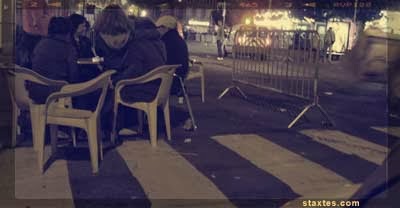
Noir Scene

For only a few seconds
He was stood outside
Next to where she waited
In the heart of the moonlight,
Peeling back her unknown promises
Behind the hiss
Of a stuttering train
In a mystery of bleached hair,

And bright red lipstick
Tangled up in each others footsteps
On a uneven texture
In the mist
Before tossing her cigarette
Back into the
Middle of the river,

And with it
The last remaining evidence
Of the crime
They’d just committed
In black and white.

*
Refugee from the Past

The hills that followed her
To the edge of the waves
Followed her like a keyhole to a door
And the waves that kissed her feet
Reminded her of her long dead cat.

The stars turned into bush fires
Mirroring the blue like breeze
Before declaring war with the sunrise
And the sand stuck to her hair
Like a refugee from the past,

And the slight fog which disappeared
As she walked slowly into the waves
Washing away her demons,

Like a spider cutting away
From it’s own web.

*
Land’s End

Over the cliff I can see
The sea choking itself
Before scattering itself
Over the rocks.

I can see the sun
Jumping up and down
The tip of the horizon
And it’s rays
Drawing the waves in
Like mermaids,

Swaying across broken flowers
And dense, un-scattered sand
Before bleeding countlessly
On the bay
In a blood soaked sunset.

Arrow drive
At Land’s end.

*

©Andy N
photo©Stratos Fountoulis, Gare du Midi5 –Bruxelles, 2009

Andrew Nicholson has published in a variety of online and paper magazines such as Other Voices Poetry, Kritya, Thanalonline, Taj Mahal Review, Remark, Unquietdesperation, Spleen, Undone since 2006. He has published in several collections ‘Emergency Verse’ and ‘Robin Hood’, (Both published by therecusant) ‘Spleen’ and, ‘Best of Manchester Poets Volume 1’ and 3 (Puppywolf Press) to name but five.

Visit All «English Wednesdays»

Lakis Fourouklas, Freebird

She wanted to do something, something small but different, not too weird but a little bit out there, out of her widely known persona. What, though? There were so many things through which she could express herself and her innermost feelings and that could really talk about her well-hidden truths, that she felt at a loss. Confused, that’s what she was, confused and kind of happy. She’d been waiting for so long and in such agony for this day to come that now that’s finally arrived, she just couldn’t decide what to do; to make up her mind as to what the gift she’s supposed to give herself would look like.


Truth be told, choices there were aplenty, but for the time being she could do nothing more but stand there, as if in a trance, and just look at them, studying their every line and curve, marvel at their beauty. What was she to do? What? She was reluctant, felt almost scared, over choosing one thing rather than the other, and she hated herself for that. Whatever she did in her life thus far, she did after giving it serious thought, after obsessing about it, and always having to worry about what the others would have to say.
The others! That’s the two words that she was going to use if anyone ever asked her what the cause of her misery was. She wanted to make love when she was sixteen, she made it when nineteen; she wanted to travel the world, she travelled too little; she had big dreams, she dreamed of achieving great things, but she’s spent thirty years of her life living a slightly different version of the same day; a routine that reminded her of death. She used to be a dreamer, now she is, as a friend puts it, the ghost of her own being. She was not who she wanted to be. She did not become the woman of her teenage fantasies.
And now, on this special day, the cursed and the blessed one of her birthday, the day that she’s decided that it would mark a new beginning in her life, she feels all the old persistent fears rising as by themselves and for themselves, out of her tortured psyche. She was afraid that she could not swim into unchartered waters; that if she escaped her routine she’d be lost; that it would be impossible for her not to follow the established itineraries and allow herself to wonder the labyrinthine paths of the unknown; she was scared of taking the stairway to an unknown heaven; of finally trying hard to make her dreams come true.
She remained standing in front of a shop’s show case, admiring the objects and the delicate designs, with almost non-seeing eyes, drifting in and out the corridors of her mind and soul, and fighting with her demons, the ones that had never given her a chance to pave her own route in life. People kept coming and going, circling around and observing her with an ironic smile or a sense of sadness, but she could not feel or see any of them. A fierce battle was taking place inside of her, and it kept getting more and more violent by the minute, as if composing an ode to psychological violence.
Every now and then she would close her eyes, trying to picture within the image that she so desperately seemed to seek, but to no avail. However, she knew; she knew that today was the day that she needed to take that first step, the most decisive one, because if she didn’t then all would be lost, her last chance would burn to ashes. Her future, tomorrow’s life, seemed to be hanging for the treacherous thread of that given moment; a decision had to be made.
The solution to all her problems and her worries was there, right in front of her eyes, staring back at her, when she had them open, but yet she could not make up her mind about how that solution should be like. She’d look at one thing and say, No, that’s not me, that’s not my world, and then she’d look at another, and a spark would momentarily lit her eyes, before receding again into the shadows.
There was an image though that kept returning time and again into her mind’s eye that has finally managed to bend her resistance, which has made her believe that, “Yes, this really talks about who I am, or rather of who I want to become.”
She stepped into the shop. There was a customer there already, so she took a sit at a not so comfortable chair and waited her turn. Little by little, a smile started taking shape on her pale lips. And then she started laughing. I can’t wait to see their faces when I show them the gift I’ve got myself, she thought, and she laughed. And she laughed! They would think she was crazy, but so what? Enough was enough; the time has come to live her own life.
When her turn finally arrived she took her sit and allowed the expert work his magic on her. Three hours later, in physical pain but a psychological high, she came out into the real world again, and she was somebody else. Half her shoulder was covered by a big black and white tattoo of an ancient boat. Yes, she was at last ready to set sail into a new life, to let the breeze lead her to a new beginning.
©Lakis Fourouklas
Photo©Stratos Fountoulis, «Ancona 1», 2011
 

Christopher Veasey, Renovation


Ian followed Adam slowly around the room in sidesteps. First the steam, then the blade.

  The thick gloss bubbled and melted before their eyes. They talked and sometimes laughed and everything rebounded off the bare walls and floor. Occasionally they stopped for cigarettes, Adam rolling his own unless Ian offered one from his packet. Despite all the doors and windows having been open for weeks, despite the chemicals and cut wood, the offensive scent of other people’s bodies dominated the air.
  ‘So how much altogether?’
  Adam half-smiled, sidestepped and applied the head of the steamer to the wall. A black plastic tube trailed from beneath his hand down between his legs and to the bubbling box behind them.
  ‘Too much. Not as much as they’d wanted.’
  Ian laughed, too much probably, he thought. He sidestepped into the dusty footprints Adam had left and scraped at the wilting paint.
  ‘I knew a girl who lived her’ he said. ‘Years back now, fifteen maybe.’ The bubbling stopped. Adam lifted the head from the wall and looked at it’s face. ‘I’ll fill it.’
  He unplugged the plug and detached the hose as Ian looked down on him. He carried what was left out of the room and out of the front door to the tap on the garage wall, feeling Ian’s eyes on his back long after they weren’t. Ian scraped at the wall, glancing over his shoulder every few seconds. He heard the water hit the bottom of the reservoir and pictured it immersing the element. He wanted to finish his story. He scraped the wall too hard. Through the paint, through the next layer, then the next, gouging the plaster and shifting from one splattered trainer to the other, the ache in his arm numbed. He heard Adam close the door behind himself. Stop. He collapsed inwards. He wouldn’t finish the story for now. He would keep it to himself. He would talk about the game and the rigmarole of house-buying, how tradesmen are. He wouldn’t finish the story for now.
  Adam was crouched behind him, re-plugging and attaching. His thighs burned in the squat. ‘Feeling old’ he thought. ‘Not old, just fucked’. Weeks of this now, ripping out and scraping, sanding and skimming, taking hold of the bathroom carpet, feeling the decades of steam and sweat soaked into it leaking out into your hands and pulling it from the floor. He looked up from the steamer to the backs of Ian’s legs. The bunch of keys in one back pocket and the wallet in the other, underneath the fadings of the denim where they had been before. The fabric pulled to the contours of him as he shifted his weight. It was tiresome t work for hours on end in an empty house with this prick and a broken radio, but we don’t truly choose our friends. Besides, they were moving in that weekend. Adam stood unsteadily, feeling the joints and muscles working, looking at the back of Ian. They would probably go for a pint when they were finished, he thought, at the Tippings Arms at the end of the street. He was resigned to it. Ian would talk. He would never be funny, though he would try. After a couple of drinks he would start leering at the barmaids, talking too loudly about them, making Adam his accomplice in the embarrassment. Adam thought about ending the day there and then with a convoluted lie involving a falsified phone call and an elaborate story about Emma, his new, pregnant, wife in trouble. But the idea of having to actually go home, as he would have to, in Ian’s car, was worse than his current situation. The steamer began to bubble.
  ‘I went to school with her.’
  Ian stopped, staring into the wall, not scraping, not quite believing what he was doing.
  Silence, bubbling.
  Adam looked at the back of his head then down at the steamer. Silence. Long seconds go by. He could hear the tone of the voice. He hadn’t heard it from his friend before, but knew that it implied a dangerous desperation. Not quite believing what he was doing –
  ‘St Marks?’
  Ian pursed his lips and inhaled through his nose, a rush of blood roaring from his feet to his head. License.
  ‘Yeah, in my year. Fucking gorgeous. We all used to hang around here. A few of them lived in this street, all around here. Just kids though, bladdered off three tins. Funny though. You’d be at home getting ready not knowing what was going to happen. You’ve seen fuck all at that age, haven’t you? Birds who though they were shit-hot at school having a couple of drinks and getting their tits out. Fucking brilliant at that age, as a kid, like, as a young lad. Sat on the park usually, just boozing. Or if somebody’s mam and dad were away you were in there, fucked, seeing what happened. This house, you should have seen it. Her mam and dad were old, in their sixties, she was the youngest. She had this dickhead brother in his thirties who tried to have a go at us all once when she came home pissed. We just stood there laughing at him and he did fuck all. This house though, light brown leather couches and sad clown ornaments on the fireplace. Paintings of little girls with puppies. It stunk of old slippers and food that’s been on all day.’
  Adam hadn’t moved. He stood at Ian’s right shoulder before approaching the wall and applying the steamers head to a thick lump of paint. He held it there for a few seconds, then moved it. Ian began to scrape.
  ‘One night we ended up here. Her brother didn’t live here anymore. About ten of us, lads and girls. A Saturday night. Bladdered. Music on, loud. I was talking to her, this girl, the one that lived here. Everybody else was in the kitchen, we were in here. She was plastered. I started asking her all these questions, taking the piss like, about what she’d done with lads. She was just laughing and saying ‘Wouldn’t you like to know’ and all that shite. I carried on, trying more, seeing how far I could go with her. For a laugh, like.’
  Adam put the steamer down and walked over to his jacket. He pulled his tobacco from the pocket and began to roll a cigarette. Ian stayed at the wall, scraping harder.
  ‘Well, she stops laughing. I carry on. Now she starts giving me a load of shit. She slaps me in the fucking face and storms off, storms upstairs. And I’m just sitting there, on the fucking brown leather, holding a bottle. I couldn’t believe it. I was looking at the kitchen door hoping nobody heard. Then I was looking at the front door, thinking about going. I couldn’t believe it. Then I was looking at the stairs. The fucking bitch. Couldn’t have a laugh pissed up on a Saturday night. Couldn’t play along. Stuck-up bitch. She was laughing, she was playing along. I necked the bottle and put it on the rug. I didn’t know what to do but I stood up. I was going to kitchen but I stopped. I was going to the stairs.’
  Adams phone rang and he looked at Ian, standing motionless, silent, never taking his eyes from the wall.   Both men breathed heavily. The ringing stopped.
  ‘Hello?’
  Adam walked out of the room to the hallway. Ian couldn’t hear, he didn’t move. Then Adam said –
  ‘I have to go…now…it’s Emma.’
©Christopher Veasey
Photo©Stratos Fountoulis,2009
 
bio

Christopher Veasey lives and works in the North of England.

Eric Mwathi, In the Minority


«Have some more couscous, Andy. After all it is not sure what the cooking will be like in the concentration camp, we’ll be sent to” said Coco, with a mischievous smile, holding a ladle, full of couscous over Andy’s plate, which Andy had held away from her, in protest, from her hand, and had said, “You will not find that joke funny once we really get sent to one, Coco.” To that, Coco had served herself that couscous, as she had rolled her eyes and had said, “It won’t happen, Andy. That one, crazy, bigot, you met in the tram, is not enough to start a second Holocaust.” Then Adam had waived his right index finger at her and had said, “Huge war crimes always start with one maniac, with evil plans, before more angry people join them in deciding to gang up on racial minorities, to do something horrible to them.” Then Coco had grabbed her spoon and begun eating large portions of her couscous as she had said, “That man was only agitated over that other fat man, who was talking to himself, because the bigot noticed that you do tend to find crazy people more and more often in the public transport, these days. You cannot blame him for complaining about that. After all, those maniacs drive me crazy as well.” Then Adam had took a gulp of his Lambusco wine and had said, “Yes, and after that maniac had staggered out of the train, the bigot had talked about the so called good, old, days, when people, like that mad man, used to be locked up at Steinhof, during the slightest hint of a mental illness. What had then hurt me was when he had complained that you cannot lock people up as much today, when supposedly every second person has got some mental disorder or other.” Then Coco had gently put her hand on Adam’s shoulder and had said, “That was not a comment that was directed towards you, Adam. There is no way that a complete stranger could know that you are in psychiatric treatment.” Adam had brushed her hand away and had said, “For four years I have been living in this area, avoiding eye contact, and showed irritation at the slightest noise, that was only a bit louder than usual. In such a long time, people do tend to notice these things.” Then she had said, “You cannot keep assuming that everyone who says something insulting automatically knows your whole life story” Then Andy had said, “Those insults were different from the ones I usually hear from the sick people I often walk into. This bigot had blamed the Socialists for failing to fight unemployment, which he says is responsible for the mental deterioration in society, and can only be solved through forced labour, as was done under Hitler’s regime. Nobody even opposed that man in his outrageous views, after he had said those things inside of a crowded tram. In fact the old man next to him had agreed with all of his views.” Whilst cutting another slice of lamb on her plate, Coco had said, “You cannot blame passengers for not quarrelling with this man. He certainly sounds insane.” Then Adam had placed his right hand onto hers, so that she had stopped using her cutlery, and then had said, “Coco, I do not think that this was why nobody had opposed him.” She tore her hands from his and had kept eating as she had said, “Yes, I know where you are coming from, Andy, but I would not read too much into this. Even you were too afraid to tell that maniac to shut up, which does not make you a supporter of his views. By not quarrelling him you wisely felt that maniacs like he are best to be ignored. So, you cannot know what the other tram passengers thought about the views of that psycho, just because they did not oppose him.” Then Andy had poured another big glass of Lambusco for himself and had said, “Having watched all of my neighbours join my landlady in tormenting me, though I did not harm or even talk to either of them, I think I know what they were thinking. People here will only criticise an inhumane, dictatorial, bigot once he is not around, so people do not find out that they in fact supported him, and long for someone to replace him and who will be just as evil.” Then Coco had said, “There is no proof that most people prefer to be ruled or to be controlled by a dictatorial tyrant and a mean landlady, instead of to live in a liberal democracy, and to have a kind person in control of important aspects of their life” Then Adam had replied, “You cannot wait for people who want you dead, to tell you about their cruel intensions to your face. It might be too late by then.” Coco then finished the rest of her Lambusco and took a deep sigh, before she had said, “Neither can you take every insult from a mad man as an automatic death threat, or you will be running away from people for your whole life.” Then Andy had said, “That mad man was not like the mad people I usually meet in the tram. Those threatening words of his were loaded with the evil intention to one day act upon his wicked beliefs.” Then Coco had looked Andy strait in the eye and had said, “I repeat, Andy, one man cannot start a second Holocaust.” Andy had shrugged his shoulders and had said, “I’m afraid this man might not be alone in his evil intentions. As a matter of fact, it might be the people who oppose him, who are in the minority.”


©Eric Mwathi
photo©Stratos Fountoulis, «Zappeion» 2005
 

Supurna Dasgupta, «They say margin gives the privilege of freedom» -poetry

 
‘Old Masters’

The night History slept with Fate, Tragedy died.
At least through its other, history had been distanced, in comedy et al.
But in this unequal match- history stood triumphant, deified.

But History knows its cunning turncoat ways,
Knows that it will die with the many,
And live commemorated in singular eternal royal days.

When I read Auden I shivered
like one among a pack of newborn cubs just out of the caves;
For until then I was looking for Icarus in the painting, and looking, and not finding him.
Auden pointed him out- those dying calves raised out of the waves.
I thought of those two legs still thrashing against fate.
Is it because that artisan’s son dared not aspire?
Did Sun burn his wings, or history with destiny did mate?

They say margin gives the privilege of freedom.

What freedom, when nearly not seen?
What margin, when it keeps closing in?

*
Another ****poem

I had a blueprint in my hands-
A book of quotes that told me what to say and where to go.
But they stretched like a skein of threads of different shades
All knotted and wound about one lonely reel.
So I took to the paper-boats that recall Tempest, Helen, World War II
And the many affections therein.
Sat and chained them together in a string of paper-sails,
A veritable army
From Yeats’ launching of a thousand ships
To the elegy on my captain.

And I wrote a letter of your name on each boat,
Such that when they drown down below,
Swimming backwards and forwards they will coagulate and name you
Paddling in a puddle of mush.

Then the world will have a new blueprint:
Of boats and corals fusing fair in **** and war
In the said and unsaid
In the named and the unnamed
In time and without
Glowing through those fishbones from the riverbed.

*
(…)

death is mundane. it makes you pick up your phone first and become a grapevine curtly letting the circuit know. Next you switch the wifi on and send letters through the clouds across the seas. Then you sit and talk until you are too tired for words. And in the middle of the night in a dark room your phone flashes with a message from the dead. in that moment of mundane presence you apprehend a spirit. then you press buttons to call back and gather more tidbits- death, bills, body, cremation. then you gasp for water and air drowning in a bad nightmare. you sink and sink and hit the seabed and bury bits of you in the sand with the shells and forget poetry and think of stories.
it is only when you are sucked dry of words and poetry
That Death comes to you:
Silently
Making eyes burn and throb
Throats ache
And sleep flee.
That
is
when
Death
C(onnives)
O(gles)
M(asticates)
E(nters)
S(mirks)
.
Puts you in parenthesis.
Elliptically
To kill language.

*
©Supurna Dasgupta
photo © Stratos Fountoulis, «Paris café» -May 2012

*

Supurna Dasgupta, 22, is a student of English literature from Delhi University

Visit All «English Wednesdays»

Brenda Wilson Wooley, Pencil Fingers

He sashayed into my life without warning and ran away with my heart. “Konstantas Dimitri Papadopoulos,” he laughed, “But you can call me ‘Costa.’”

We met at my best friend’s wedding. I was maid of honor; he, best man. Slim and graceful, with startling black hair, his high cheekbones and arched Roman nose put me in mind of a tall, slim Al Pacino. Although his true love was art, he made his living as a chef at an upscale Manhattan eatery. He had recently moved back home to the Detroit suburb of Bloomfield Hills to pursue his dream.
“It’s now or never; I’m giving myself one more chance to make it with my art,” he said, “If not, I guess I’ll be forced to give it up.”
Costa was electrifying, impulsive, and dangerous; a free spirit, one of a kind. The most exciting man I had ever met. It was only after we married that I realized there were two sides to him. Many sides, really. But the good times were so enchanting that I anxiously awaited them. He encouraged things I would never have done before he came along, singing our favorite Air Supply song, “All Out of Love” in a packed Karaoke bar, running naked in the rain, smoking pot, flipping the bird to drivers who cut me off on Telegraph Road. And trading obscenities with him during our screaming fights.
He painted my portrait as I lay naked on our bed, his worn bomber jacket draped across my thighs. He taught me Greek dances as the musicians strummed their mandolins in the dark, cozy bars down in Greek Town. He took me to Reggie’s, where we danced the night away to the old Motown sound, and to Flood’s Bar & Grill, where we dined on soul food and listened to smooth jazz.
But the best times were our nights at home. And the best of them all was the rainy night of our last wedding anniversary. He zipped around the kitchen, preparing Spanakopita, Dolmathakia; Moussaka and Baklava, yelling “Opa!” as he lit the flame, squeezed lemon juice and a smattering of Cognac over the sizzling Kefalotere cheese, serving it all with the pizzazz of the superb chef that he was.
Costa dined like he made love, slowly, savoring each course, a look of pure joy on his face. “What a delight,” he said, taking sensuous bites of the filo-layered spinach pie, tangy stuffed grape leaves, creamy Moussaka. Washing it down with cheap red wine.
“More Dom Perignon, madam?” he said, bowing gracefully.
Everything about him was graceful: his long, slim legs whirling me around the dance floor; his flowing arms, pretending to direct an orchestra when he was tipsy from too many Rusty Nails; his artistic fingers, so long that friends called him “pencil fingers.”
We planned our future as we smoked a joint, legs entwined on our old tattered sofa. “You’re the next Eudora Welty,” he said, tracing my eyebrow with one long, tapered finger. “You’re the next Jackson Pollock,” I said, running my fingers through his black, silky hair.
Later, his gold-brown eyes held mine as we made love to the sound of the rain falling softly on the eaves.
But, like flipping a switch, things always changed.
“Why are you ruining it all?” I cried.
We had just arrived home from visiting an Air Force buddy who had served with him in Vietnam. We had enjoyed a lovely evening with Mark and his wife Cindy. Until Costa and Mark closeted themselves in the den with a bottle of Ouzo. Cindy and I sat in the living room, trying to ignore their talk about “Nam,” the Viet Cong, “jarheads,” babies with bombs strapped to their diapers and whores with razor blades in their vaginas. Subjects which had become all too familiar to me.
“You don’t understand, Sarah, you can’t possibly understand,” he said, “I’ve fucking murdered men, women and children. Babies, god damn it, tiny, innocent babies!”
I held him in my arms until he fell asleep. And I lay awake the rest of the night.
“I promise that will never happen again, sweetheart,” he said the next morning, taking a sip of tomato juice mixed with hot sauce, his cure for a hangover.
“You need help.”
“How many times have I told you, I’m not going to a god damned shrink? They don’t understand. Nobody understands!”
The nightmares began coming more often, the night sweats and flailing, scrambling for cover. “Gooks!” he screamed, “Look! They’re right there in the bushes! Fuck! Watch out! No, no, no!”
He clung to me when I awakened him, thin body slick with perspiration, hands shaking as he lit one Marlboro after another. He never slept after the nightmares. Not that he slept much anyway.
He began spending more time away from home, obsessing about Vietnam, painting less and less, fits of anger, fists through doors. And his infidelities.
“Give me another chance, my love,” he said, gathering me in his arms the mornings after, “Please.”
And I did. Time after time. But I felt I was hanging by a thread at the peak of a cliff, slipping toward the swirling abyss below.
And, as it turned out, I was.
It was around three o’clock on a freezing February morning when I received the call. I don’t remember getting dressed or even leaving the house; I suddenly found myself speeding down 13 Mile Road, sleet spitting at the windshield. And when I arrived at Beaumont Hospital, all I could see was a clutch of people in white, all staring at me.
As the doctor moved toward me, a thin veil descended over my vision, dim and moving, shifting and blending, mind numb, body frozen, thoughts fading in, fading out. He spoke the words in a soft, gentle voice, the sounds around me receding; muffled, like underwater. But they struck with the force of a sledgehammer.
“No!” I heard myself cry out through the haze, “No!”
I waited two long weeks before I let them take him off life support. Thick, heavy snowflakes drifted past the window that cold, gray morning as I kissed his parched lips, touched his smooth, familiar face, caressing his hands and committing to memory his long, pencil fingers.
I am no longer the woman Costa knew, nor am I the woman my family and friends know. She is boxed up; put away, along with his cards and gifts, pictures, the painting of me with his bomber jacket draped across my thighs, and the tiny gold locket in which I placed a lock of his black, silky hair.
There are times, though, when the faint strings of a mandolin drift through a soft summer night, or I hear Air Supply’s “All Out of Love,” or a Greek waiter yells “Opa!” and I am cuddling with Costa on our tattered sofa, his gold-brown eyes holding mine as we make love to the sound of the rain falling softly on the eaves.
©Brenda Wilson Wooley
photo © Stratos Fountoulis, «Hoeilaart», 2011
bio
Brenda Wilson Wooley’s work has appeared in more than forty-five publications in the United States and around the world, including The Birmingham Arts Journal, Kentucky Monthly Magazine, Barely South Review and Looking Back Magazine. She lives in Paducah, Kentucky, where she is working on a novel.

Bill Yarrow, “Expose those for whom freedom is greed” -poetry


THE CITY RISES IN ME

Cities! Cities! I have lived
in cities: habitual, arrogant,
cities circumscribed by cities,

on the alert for alacrity,
filled with false vitality,
rising revised out of history,

burgeoning cities bloated
with stoic pride, notorious
for hope, filled with ethical travail.

These cities, yes, but also
cities reticent, inferential,
embedded with desuetude.

A decade here, a decade there,
to what end? Position. Man needs
locus, not looseness, in his life.

What’s a road? A swift excuse
for a city at each end. What is
not a city? Nothing.

Socrates lived in a city.
So did Meyer Lansky. The city
rose against them. That’s what

cities do; they rise,
sometimes in us,
sometimes against us.

The city rises in me.
I hear it whisper.
I ignore its roar.

*
TARIFF HAPPY

Be subversive in your chores.
Knock at the door of indecency and demand to be let in.
Factor in your final calculations the weight of longing among the self-assured.
Do not fob off.
Keep a second set of books for Raphael.
Inculcate imprudence.
Wash with emotion, then with good soap.
Expose those for whom freedom is greed.
Scour the future so as to inure it.
Keep lists.
Change the air in your protocol every time you crave a tattoo.
Lock your knees before you do anything wily.
Wear linen at funerals.
Hands off the secret levers of the world.
Watch out for the kids of Narcissus.

*
THE BEAUTIFUL MERCEDES

No one who saw the beautiful Mercedes
in the summer of 1966 could ever forget her.
When she walked into Café Danglars, heads turned.

I was sent upstate for two years for passing unpopular
checks, but when I got out, I went back to the Café
just to catch a glimpse of her again. It took a month
but she did return. I was there that day, sitting at
the counter in my Bermuda shorts, sucking a 7-Up.

The screen door slowly opened. I was expecting the second
coming of perfection. Not quite. She was bloated like a
bagel. Her thighs looked like freezer bags filled with dimes.
There was no necklace anywhere that could fit around that neck.

Two years earlier, she was real money, a class investment.
When she ate up all her principal, well, we lost interest.

*
RESURRECTION HAPPENS

The doctor diagnosed it as walking pneumonia
but Cid knew better. He had (hadn’t he?)
suffered trauma when Marguerite died of AIDS.

Jesus, he was in a coma. Except he could see.
And hear. And feel. Walk around. And talk.
Damn it, it was. A kind of walking coma.

One where he could remember but not
exactly remember, communicate but not really
communicate, exist but not fully exist.

Then one day all the symptoms just vanished.
He stopped using, got his CDL, drove to Reno,
married a dealer, agreed to raise her kid.

It’s possible to forgive the past its trespasses
stop seeing the future as a threat, reimagine
the present as a goal. Yes, resurrection happens.

*

© Bill Yarrow
Photo © Stratos Fountoulis, “Plateia Derveni, August 2011”

Bill Yarrow is the author of Pointed Sentences, a full-length collection of poems published by BlazeVOX in 2012 and two chapbooks–Wrench published by Erbacce Press in 2009 and Fourteen, published by Naked Mannekin Press in 2011. He has been published in many print and online journals including Poetry International, PANK, Thrush, DIAGRAM, Contrary, and RHINO. He is a Professor of English at Joliet Junior College where he teaches creative writing, film, and Shakespeare, all online. Two chapbooks (Twenty from MadHat Press and Incompetent Translations and Inept Haiku from Červená Barva Press) are forthcoming in 2013.

Felino A. Soriano, “… in the apparitional momentum of memory” -poetry

from Of isolated limning

of Wednesday, the oddity of this summer’s rain becoming subsequent

I found thunder
its thickened wrap in
the apparitional momentum of memory——————-when
whole fruition exercises space into
wealth and the body’s building of
tonal silences ——————————————- this
surprise of amalgamated loudness
reinvents angles’
and
—-their
————-fundamental
—-exposure to
positional freedom of fear-articulation of
physiognomy’s vocal
clarification

*
of watching the mother-daughter mirror’s interaction

in the silent combing a hand
commits solace, tooth-silk
————-slide
afterward the tonal clarity
of reflection rests
in the purpose of self’s
time of added
interactions

*
an endeavor of watching a contour

when rising acclimates its meaning
beyond sun and the body of becoming

a tiredness must rest across page and plural
of the unmarked lassitude

this rest burgeons beyond fiction of the
unbelieving and

casts width of a moment’s quickened disposition
lasting then when or if favor is in the mood

moderating a glass’ shard mixture of sharpened
shaped light, the devotional fixation of light,

insinuating all interaction oscillates, asking when
motion invents an altered interrogation

*
© Felino A. Soriano
Photo © Stratos Fountoulis, «Polytechneio, 2009» -Athens.Gr. 

Felino A. Soriano is the founding editor and publisher of Counterexample Poetics, an online journal of experimental artistry, and the founder of Differentia Press, an electronic-book press dedicated to publishing experimental poetry. He is also a contributing editor at Sugar Mule.
Over 4,100 of his poems have been accepted for publication in over 500 online and print journals since 2006, including experiential-experimental-literature, BlazeVOX, 3:AM, Humanimalz Literary Journal, indefinite space, Full of Crow, Otoliths, Clockwise Cat, Unlikely 2.0, and others. Also, he has 60 print and electronic collections of poetry accepted for publication since January, 2008, including Extolment in the praising exhalation of jazz (Kind of a Hurricane Press, 2013), the collaborative volume with poet, Heller Levinson and visual artist, Linda Lynch, Hinge Trio (La Alameda Press, 2012) and rhythm:s (Fowlpox Press, 2012).

All English Wednesdays